Men's work-boot aisles offer many W and EW labels, yet those letters do not tell you where volume was added. A broad square-toe pull-on may have generous forefoot width but loose heel hold. A lace-up may secure the ankle well but place the cap edge over the little toe. The useful comparison is the three-dimensional last, not the label in isolation.
The candidates listed here span lace-up and pull-on constructions and should be treated as a fitting shortlist. Confirm the current product marking and technical sheet for any impact, compression, electrical, puncture, waterproof, or outsole claim. Fit changes by size and individual anatomy, so no model earns a universal comfort claim simply because one listed variant is wide.
Identify the kind of wide fit you need
A wide forefoot, high instep, thick ankle, and high-volume foot are different fitting problems. Trace pressure after a normal shift and measure both feet rather than relying on an old casual-shoe size. If discomfort is concentrated at the cap edge, prioritize a different cap and last geometry. If laces barely close over the instep, look for more vamp volume and an appropriate throat opening.
Feet can change over time and often differ from each other. Measure late in the day with work socks and any approved orthotic. Significant new or one-sided swelling deserves medical attention rather than indefinite footwear experimentation. The purchasing goal is enough functional room for expected daily volume change without leaving the foot free to rotate or strike the cap.
Use the named candidates to test different fits
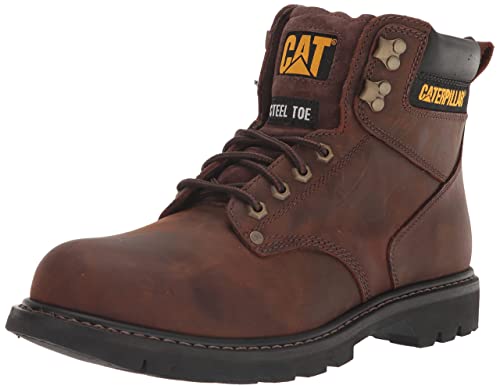
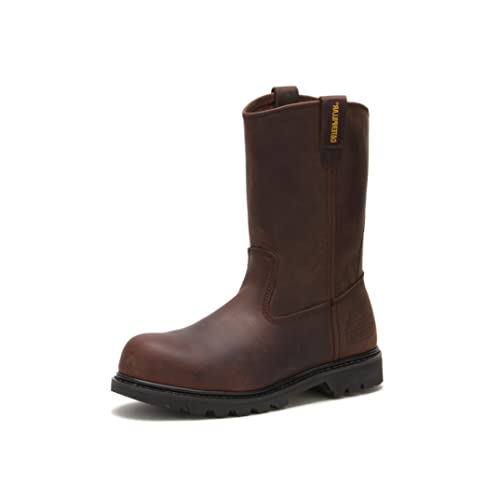
Begin with the CAT Second Shift steel-toe family if adjustable lacing is the key requirement. Compare the CAT Revolver Steel Toe if a pull-on construction better suits the work. The Ariat Groundbreaker Wide Square Toe Steel Toe offers another pull-on shape, but its broad-looking front still needs an actual toe-cap fitting.
Do not order three CAT Second Shift color and size entries expecting three different lasts. They are variants of the same family. Confirm the selected width and safety-toe version, then compare it against a genuinely different construction if the heel and forefoot cannot both be fitted.
Compare lace-up and pull-on retention
Lace-up boots allow targeted adjustment at the forefoot, instep, and ankle. That makes them useful when the heel is narrow relative to the forefoot, provided lacing does not crush the instep. Pull-on Wellington and Chelsea constructions remove loose laces and simplify changes, but they depend on a well-matched heel pocket, shaft, and instep to retain the foot.
Test both designs on ramps and stairs. A little heel movement in a new pull-on can occur, but sliding that creates friction or drives toes forward is not acceptable. In a lace-up, ensure the heel remains seated without overtightening and reducing circulation. Choose the construction that stays secure during the actual gait and postures of the job.
Demand toe clearance in motion
The longest toe needs clearance when standing, and all toes need space above and beside the cap. Walk downhill and kneel because forward slide and forefoot expansion reveal contact that a seated try-on misses. The boot should bend near the ball of the foot; if it folds too far forward or backward, extra length may have displaced the flex point.
Do not count on heat, wear, or a stretcher to enlarge a steel cap. Modifying protective footwear may damage it or affect compliance. Instead, compare another width, last, or model. If a boot is spacious at the cap but loose elsewhere, experiment only with ordinary lacing adjustments or manufacturer-approved fit components while the pair remains returnable.
Filter by trade and surface
Construction debris, warehouse concrete, ladder work, farm mud, welding exposure, and utility tasks impose different demands. Consider boot height, defined heel, tread cleanability, upper material, and environmental exposure. Waterproof membranes can reduce water entry below the collar but may retain more heat. Pull-on leather is not equivalent to a molded rubber boot in standing water.
Separate the standards. A steel toe does not automatically provide puncture resistance, metatarsal coverage, electrical hazard protection, static dissipation, or verified slip performance. OSHA assigns selection duties to the employer; it does not approve branded models. Obtain the written footwear rules and confirm the exact style's current marking instead of relying on a family name.
Evaluate long-shift support without hype
Comfort comes from fit, stable support, temperature management, sock compatibility, and the match between flex and task. Maximum cushioning is not always best on ladders or uneven surfaces. A removable footbed can create options, but a thick replacement may reduce cap height and heel depth. Ensure any change is permitted and does not destabilize the foot.
Inspect feet and boots after the indoor trial. Redness at the cap edge, numbness, burning, blister-prone heel movement, or one-sided pressure are rejection signals. Mild leather stiffness around the shaft can soften; rigid toe pressure will not. Keep return packaging intact until the pair passes the full movement sequence with the intended sock system.
Exact Amazon listings
Products to compare for this guide
Affiliate disclosure: As an Amazon Associate, we may earn from qualifying purchases. Product titles, images, ASINs, and destinations are matched to the exact listing; prices and availability remain on Amazon.




Sources and model documentation
Frequently asked questions
Best Wide Steel Toe Boots for Men FAQ
What does EW mean in men's work boots?
It usually means extra wide, but the dimensions and added-volume location vary by brand and model. Consult the exact maker's chart rather than assuming equivalence.
Are square-toe boots always wider?
No. The exterior shape can look broad while the internal cap or last narrows. Judge usable space through fit and model-specific dimensions.
How much heel slip is acceptable in pull-on boots?
Some small movement can occur in new pull-ons, but repeated lift, rubbing, instability, or toe impact means the fit should be reassessed.
Can men with high insteps wear steel toe boots?
Yes, if the model provides sufficient vamp and throat volume while retaining the heel. A wider label alone may not solve an instep-specific pressure point.
Final verdict
What to do next
Men's wide steel toe boots should be chosen by last shape and job, not width letters alone. Map the foot's volume problem, preserve correct length, and test security and cap clearance through work-like movement.
A shortlist is valuable only when every candidate also meets the employer's exact protective-footwear policy. Fit and hazard protection are parallel requirements; neither can substitute for the other.
Compare Wide Steel Toe Boots