Molded waterproof boots and waterproof leather boots address wet work with different constructions. A molded shell can reduce seam exposure, while a leather lace-up provides adjustable fastening. Those are useful distinctions, but neither material alone establishes better support, walking comfort or chemical protection. Compare the complete models against the same route and exposure.
The right comparison is exposure-specific. How deep is the water? Is the boot immersed, splashed, or simply used in rain? Which chemicals or biological contaminants are present? How far will the worker walk, and must the route include ladders or hard indoor floors? Answering those questions prevents 'waterproof' from becoming an all-purpose label.
Water exclusion and the collar limit
An intact molded rubber or PVC shell can provide continuous water exclusion through the covered area. Its limit is the top opening and any damage. A waterproof leather boot usually relies on a membrane, sealed seams, a gusseted tongue, and treated outer material. Water can still enter above the gusset or collar, and prolonged saturation can challenge construction and drying time.
Select shaft height around credible splash and standing-water depth, not the deepest puddle someone hopes to cross. Kneeling lowers the effective opening and clothing can channel water inside. If water routinely approaches the collar, the job may require coordinated waders or other PPE chosen by the employer rather than a taller boot alone.
Walking, climbing, and fit
Leather lace-ups usually permit more precise heel and instep adjustment. Their shaped midsoles and ankle structure may suit long walking routes, slopes, and ladders, depending on the model. Pull-on molded boots rely on last shape and can feel less controlled when oversized. Stiff shafts can also interfere with crouching or vehicle controls if the geometry is poorly matched.
Molded boots can be convenient for quick changes and easier exterior rinsing. Test heel lift, forward slide, cap clearance, shaft rub, and flex through real work postures while indoors. A little pull-on movement may be expected, but blisters, rotation, or toe impact are not. Do not use thick socks to rescue a boot that is too large for safe control.
Chemical, biological, and heat exposures
Material names do not establish chemical compatibility. Natural and synthetic rubbers, PVC compounds, leather finishes, membranes, adhesives, and threads respond differently to specific substances. Request a compatibility chart for the exact complete boot using the chemical, concentration, temperature, and contact duration. A claim for one acid or oil should not be generalized to all washdown chemicals.
Molded waterproof shells can retain heat and sweat, while leather systems may breathe differently but still become warm behind a membrane. In cold conditions, insulation and sock management matter; in hot conditions, drying and rotation become important. Neither construction prevents biological exposure once contaminated liquid enters the top or penetrates damaged material, so workplace decontamination procedures remain essential.
Traction across changing surfaces
Rubber boots often use open lugs for soft ground, while leather work boots offer many outsole patterns for hard floors, ladders, or mixed terrain. Those are tendencies, not guarantees. Deep lugs can hold mud and feel awkward on smooth concrete; shallow channels can clog outdoors. Compare model-specific whole-shoe testing where relevant and never call either option slip-proof.
Transition zones deserve special attention. Clear packed tread before stepping onto tile or metal, maintain drainage and mats, and report repeated near-slips. Oil resistance describes material behavior and is not the same as traction in oil. The employer's floor controls and housekeeping process may have more influence than switching upper materials.
Protection, maintenance, and lifespan
A steel toe can be built into either construction, but every additional feature is separate. Verify impact and compression markings, puncture resistance, metatarsal protection, electrical classification, and any outsole standard on the exact style. OSHA does not approve models. The employer must select adequate footwear for identified hazards and may impose material or height rules beyond a general standard.
Rinse and decontaminate only as directed, remove compatible footbeds for drying, and avoid damaging heat. Leather may require approved conditioning that preserves membrane and outsole bonds; molded boots need close inspection at flex lines and attached components. Replace either type after cracks, separation, cap damage, unremovable contamination, or tread wear compromises serviceability.
Exact Amazon listings
Products to compare for this guide
Affiliate disclosure: As an Amazon Associate, we may earn from qualifying purchases. Product titles, images, ASINs, and destinations are matched to the exact listing; prices and availability remain on Amazon.


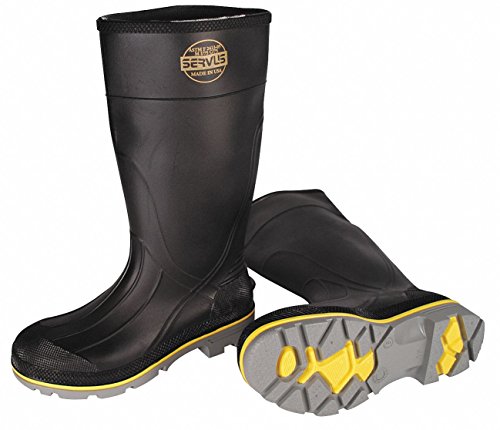
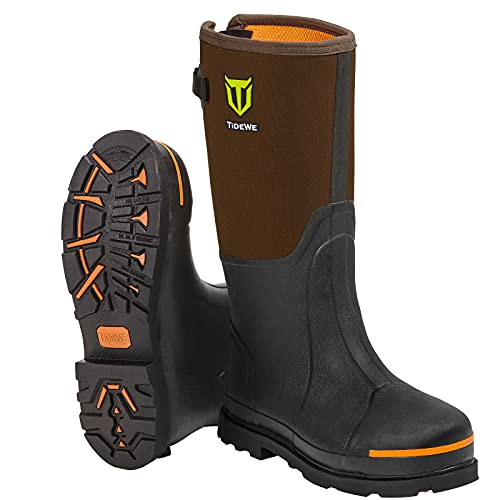
TIDEWE
TIDEWE Rubber Work Boots for Men, Steel Toe & Shank, Brown, Sizes 11
ASIN B08C5FVMML
View on Amazon
Sources and model documentation
Frequently asked questions
Rubber vs. Waterproof Leather Work Boots FAQ
Are rubber work boots more waterproof than leather boots?
A continuous molded shell has fewer water-entry paths through its covered area, but both types are limited by openings and damage. A well-built waterproof leather boot may be better for long mixed-terrain walking.
Which is better for mud?
Molded boots with open, cleanable tread often suit repeated mud, but the correct choice depends on fit, depth, walking distance, and whether the route transitions to hard floors.
Which lasts longer?
There is no universal winner. Exposure chemistry, flexing, care, drying, tread wear, and construction quality determine service life. Inspect rather than replacing by category alone.
Can waterproof leather boots be used in standing water?
Only within the manufacturer's stated limits and below the opening. Repeated immersion may favor a compatible molded boot, while deeper exposure may require other employer-selected PPE.
Final verdict
What to do next
Molded steel toe boots favor repeated wet, muddy, and rinseable work; waterproof leather boots favor adjustable fit and mixed-terrain walking. Water depth, material compatibility, gait, and required markings should decide the category.
Do not let the word waterproof erase collar height, damage, or chemical limits. Confirm the exact model and build the choice into a broader inspection, drying, housekeeping, and exposure-control program.
Compare Steel Toe Rubber Boots