A men’s steel toe shoe sizing guide cannot replace trying the exact model because the protected interior is shaped by both the last and rigid cap. Two shoes marked with the same length and width can place the cap edge differently. Your casual size is useful context, but it is not permission to tolerate contact in a work shoe.
The fitting goal is more precise than simply leaving extra room: maintain cap clearance while keeping heel and midfoot movement under control. This guide explains measurement, width diagnosis, socks, insoles, and motion checks so a sizing change addresses the correct dimension.
Men's steel toe shoe sizing guide: measure both feet
Measure length and width for each foot while bearing weight, using the maker’s current method or a reliable footwear fitting device. Feet can differ, so the longer foot usually establishes required length. Take the measurement when foot volume is representative of work, rather than relying on an old size from another brand.
A numerical size only chooses a starting pair. Last shape, cap taper, toe-box height, and heel volume determine whether that pair works. Repeat the assessment whenever changing models, even within a brand, because similar styling can hide different internal geometry. Record the exact style, successful size, and sock thickness for later reference, then still fit-check each replacement pair before work.
Fit with work socks and approved insoles
Wear the sock thickness intended for the job. A thick sock consumes width and height, while a thinner sock can leave excess volume and friction. If seasons require different socks, the closure must adjust without making either setup unstable.
An added insole changes position as well as cushioning. It can raise the heel and toes, reduce cap clearance, and alter where the shoe bends. If an insert is allowed, test it inside the shoe from the beginning and confirm that it lies flat without crowding. Seek professional guidance for individual medical concerns rather than expecting footwear copy to diagnose them.
Check front, side, and top clearance
Stand and spread the toes naturally. No toe should touch the cap’s front, sidewall, or roof. Walk downhill or descend stairs because the foot can shift forward; crouch because the forefoot changes shape. Pressure that appears only in motion still counts as a sizing failure.
Do not rely on pressing the exterior toe to locate toes, because the cap blocks that feedback. Instead, focus on sensation, heel position, and comparison with another size or width. The protected area cannot be stretched later.
Diagnose length versus width
Forward contact at the longest toe, with the heel seated, suggests insufficient length. Side pressure with ample forward clearance points more toward width or taper. Top pressure can indicate inadequate vertical volume or an insole that is too thick. A loose heel combined with generous toe length suggests the shoe may already be too long.
Wide versions of the Skechers Cankton provide a useful comparison with its standard widths. Try medium and wide at the same length where possible. A different model may be necessary if extra width also makes the heel too loose.
Control heel lift without crushing the instep
Some tiny settling movement can occur in new footwear, but repeated lift or friction during ordinary walking signals poor retention. Adjust lacing through the midfoot and collar without creating numbness or forcing the foot forward. A shoe that requires painful tightening is the wrong volume or shape.
Slip-on models such as the Skechers Hartan depend on instep and opening geometry rather than laces. Test them during turns and stairs. Do not purchase a loose slip-on merely because it is easier to enter.
Use a clean indoor fit protocol
Protect the return option and test both shoes on a clean surface. Recreate work movements long enough for minor rubbing or migration to show. Compare candidate pairs back to back; memory is less reliable after hours between fittings.
- Stand several minutes with weight evenly distributed.
- Walk fast, turn, and stop without toe impact.
- Use stairs or a safe incline to test forward slide.
- Crouch and check cap-edge sensation.
- Inspect socks for friction points after the trial.
Exact Amazon listings
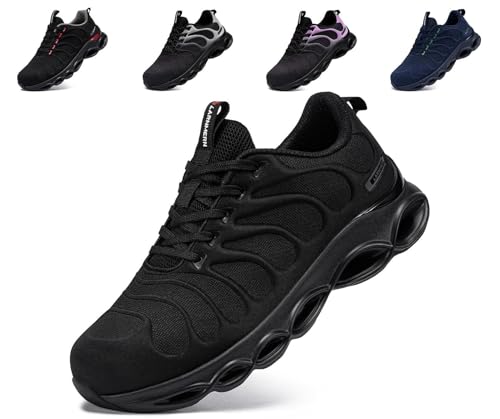
Products to compare for this guide
Affiliate disclosure: As an Amazon Associate, we may earn from qualifying purchases. Product titles, images, ASINs, and destinations are matched to the exact listing; prices and availability remain on Amazon.


Sources and model documentation
Frequently asked questions
Men’s Steel Toe Shoe Sizing Guide FAQ
Do men’s steel toe shoes run small?
There is no reliable category-wide rule. Sizing varies by model and last. Begin with measurements and the maker’s chart, then verify the exact protected fit through movement.
How much toe room should steel toe shoes have?
Enough that no toe touches the rigid cap while standing, walking downhill, or crouching, without so much extra length that the heel lifts. Sensation and control are more useful than one universal gap.
Should I choose wide or size up?
Choose wide when length is adequate but side volume is lacking. Size up when the longest toe lacks forward clearance with the heel properly seated. Another last may be best if either change destabilizes the heel.
Can I break in a tight steel toe?
The surrounding upper may soften, but the cap will not. Rigid contact should prompt a size, width, or model change before the shoes are worn to work.
Final verdict
What to do next
Correct sizing balances two goals that are sometimes confused: clear the cap and control the foot. Measure both sides, reproduce the real sock-and-insole setup, and use movement to locate the mismatch. A bigger number is not automatically a better fit.
When pressure is lateral, compare width and toe shape. When it is forward, revisit length and heel seating. When heel lift persists, change volume or last. That diagnosis produces a more dependable result than hoping a rigid toe area will break in.
Compare Men’s Steel Toe Shoes