The choice between slip-on vs. lace-up steel toe shoes is really a choice between fixed geometry and adjustable retention. A loafer can be quick and clean when its heel, instep, and forefoot match the wearer. Laces offer more ways to tune those zones, but they add tying time, can loosen, and need routine attention.
Neither entry system changes the fact that the protective cap is rigid. Both styles can fail through side pressure, inadequate vertical room, or forward sliding. Compare them using the same socks and movements, then weigh the result against footwear-change frequency, walking pace, kneeling, stairs, and the site’s rules for coverage and loose components.
Slip-on vs. lace-up steel toe shoes at a glance
A slip-on uses elastic panels, collar tension, or a close instep to hold the shoe. That makes entry efficient but leaves limited adjustment after purchase. A lace-up distributes tension through eyelets and can be loosened at a sensitive forefoot while tightened nearer the ankle. Its useful range is still finite; laces cannot transform the wrong last.
- Slip-on advantage: quick on-and-off with no lace ends to manage.
- Lace-up advantage: separate forefoot, instep, and collar tuning.
- Shared requirement: full cap clearance while standing and moving.
- Job filter: surface, exposure, coverage rules, and movement pattern.
Compare heel hold under acceleration
Slip-ons deserve special attention during fast starts, turns, and stairs because the foot must stay seated without lace tension. The heel should not climb repeatedly or shift sideways. A good fixed last can feel exceptionally simple; a poor one encourages toe gripping and lets the foot strike the cap during abrupt stops.
Lace-ups can draw the rear inward, but overtightening is not a real fit solution. If heel lock requires painful instep pressure or causes the upper to bunch deeply, rear volume remains mismatched. Run the same figure-eight and step test in both styles, using comparable lengths and widths.
Account for sock and foot-volume changes
Feet and sock systems do not remain identical across seasons or shifts. Laces accommodate small changes more readily because tension can be reset. Slip-ons have a narrower useful volume window: a thin sock may allow lift, while a thick sock may make entry difficult or compress the instep.
That does not make slip-ons unsuitable; it makes consistent fitting more important. Test with the exact sock combination used most often. If the job rotates between substantially different socks or compatible footbeds, the adjustable format may be more forgiving, provided every configuration leaves the toes below and behind the cap boundaries.
Evaluate entry speed and daily upkeep
Workers crossing footwear-controlled boundaries may gain meaningful time from a slip-on. Its opening should flex and recover without the wearer stepping on the heel counter. Lace-ups take longer but open more widely, which can reduce the force needed to insert a high-instep foot. Speed should be judged over real daily changes, not a single fitting-room attempt.
Each system has inspection points. Slip-on gores and collar stitching handle repeated strain; laces and eyelets need checks for wear and secure tying. Dirt around either opening can affect comfort. Entry design is useful only while it continues to hold the foot as intended.
Keep cap clearance independent of closure style
Stand, crouch, walk downhill, and stop in both candidates. Toes must not touch the front, side, or top of the cap. A lace may reduce forward movement, but it cannot create internal cap width. Conversely, a well-shaped slip-on may control motion without being tight through the forefoot.
When cap contact appears, identify its source. A hard side edge suggests width or taper; front impact paired with heel lift suggests excess motion; roof pressure may worsen with a thicker insole. Solve the specific geometry instead of awarding the category decision to whichever style happens to be tried first.
Let job context break the tie
For predictable indoor floors and frequent changes, a secure safety loafer can be a practical choice. For high-mileage shifts, variable sock thickness, or tasks that benefit from precise lockdown, lace-up safety sneakers often provide more control. Neither low-cut option replaces boot coverage where terrain, debris, weather, or employer policy calls for it.
Use the exact model record to verify all required features because closure style says nothing about other workplace properties. Then perform equal-length indoor trials. The better system is the one that stays seated, clears the cap, and requires fewer compromises during the most demanding routine movement.
Exact Amazon listings
Products to compare for this guide
Affiliate disclosure: As an Amazon Associate, we may earn from qualifying purchases. Product titles, images, ASINs, and destinations are matched to the exact listing; prices and availability remain on Amazon.


LARNMERN
LARNMERN Slip On Steel Toe Shoes Men Loafers Work Safety Sneakers, Black 10
ASIN B0C821TLQD
View on AmazonLARNMERN
LARNMERN Slip On Steel Toe Shoes Men Loafers Work Safety Sneakers, Black 11
ASIN B0C82374TY
View on Amazon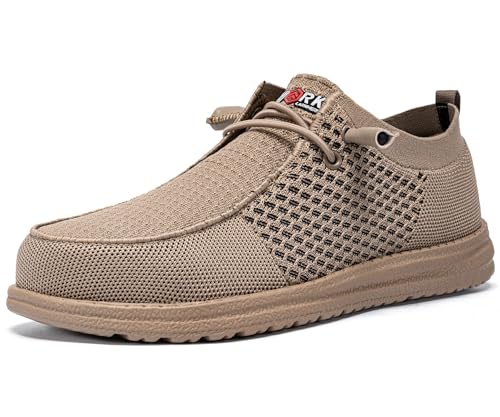
LARNMERN
LARNMERN Slip On Steel Toe Shoes Men Loafers Work Safety Sneakers, Khaki 12
ASIN B0D1V394WQ
View on Amazon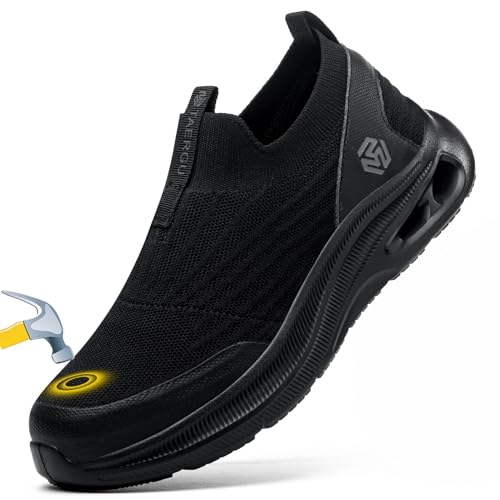
Frequently asked questions
Slip-On vs. Lace-Up Steel Toe Shoes FAQ
Are slip-on steel toe shoes safer because they have no laces?
They remove loose lace ends, but overall suitability still depends on secure fit, full hazard requirements, and the work environment. A loose slip-on introduces its own movement problems.
Do lace-ups fit wide feet better?
Laces can adjust upper tension, but they cannot widen a rigid cap or change the underlying last. Start with an appropriate width and use laces for fine control.
Which style is better for a high instep?
It depends on the exact opening and last. Lace-ups usually open and adjust more, while a slip-on must have sufficient fixed instep volume without losing heel hold.
Can a slip-on loosen after repeated wear?
Entry materials and collars experience repeated stress, so inspect their recovery and condition. Do not start with a painfully tight shoe in the hope that cap-area pressure will relax.
Final verdict
What to do next
In men’s slip-on vs. lace-up steel toe shoes, the decisive difference is how fit is controlled. Slip-ons reward an already compatible last; lace-ups offer finer adjustment but still require the correct base shape.
Choose with the real sock, shift pace, and change routine in mind. Whichever closure wins must hold the heel without crushing the instep and preserve cap clearance through the hardest movement of the job.
Compare Men’s Slip-On Steel Toe Shoes