The lightest steel toe shoes cannot be ranked responsibly from inconsistent listings. Weight may be stated for one sample shoe, one pair, or an undisclosed size, and larger sizes naturally use more material. Titles that say lightweight or ultra lightweight are useful leads, but they are qualitative claims rather than a common scale.
Listings for BAIYIJIA, LARNMERN, Ruivina, DRRHINO, and Hogent use lightweight wording alongside steel-toe claims. Those claims need checking against exact model documentation. This guide explains how to compare those candidates without inventing ounces and why total construction, fit, and job suitability matter more than winning a marketing superlative.
Lightest steel toe shoes require comparable measurements
Ask for four details: exact style, sample size, whether the number covers one shoe or the pair, and the measurement method. A men’s size 13 wide cannot be compared fairly with a smaller women’s sample. When those details are missing, treat weight language as directional only.
Use a consistent scale if comparing purchased candidates at home, and weigh complete shoes with their supplied insoles and laces. Do not remove components used on shift merely to create a lower number. Record the size so the result remains interpretable.
Why total shoe design outweighs cap stereotypes
Cap material influences construction, but outsole thickness, upper, cushioning, hardware, width, and size all contribute to total weight. A steel-toe athletic shoe can weigh less than a substantial non-steel design. Never infer an exact total from the cap label alone.
The Stratus N1911 marketplace title illustrates why adjectives are insufficient: it claimed steel toe, but SureWerx identifies an aluminum alloy toe. Exclude it from a steel-only weight comparison. The remaining lightweight listings do not supply enough comparable numeric evidence here to declare an absolute winner.
Perceived lightness includes fit and swing
A loose heel makes the wearer work to retain the shoe, and a misplaced flex point can feel clumsy even at a low scale weight. Walk at work pace, turn, stop, and climb stairs. Notice whether the shoe moves with the foot or has to be managed.
Weight distribution matters too. A front-heavy sensation may be more noticeable than the same total mass distributed differently. That experience is individual and cannot be derived from a title, so an indoor trial remains essential.
Do not trade away cap clearance or stability
The toes must avoid the rigid cap at the front, sides, and top. A narrow lightweight upper is not an advantage if it compresses the protected zone. Compare width and last before sizing longer, which can introduce heel lift and forward movement.
Underfoot softness can also create a deceptive first impression. Choose cushioning that remains predictable through turns and standing rather than the least material or softest foam. The lightest acceptable candidate is the one that still controls the foot.
Retain every feature the work requires
Reducing weight does not relax the hazard assessment. Verify toe marking, outsole needs, electrical or static properties, puncture protection, upper coverage, and any water requirement independently. Some of those constructions can add mass, but omitting a requirement is not a legitimate weight saving.
Low-cut textile models often target dry indoor mobility. Wet, sharp, hot, debris-heavy, or uneven settings may require a different upper or a boot despite added weight. Choose the lightest format within the acceptable set, not across unsuitable categories.
Build a defensible lightweight shortlist
Start with exact lightweight-title evidence, then request comparable specifications. BAIYIJIA and LARNMERN offer men’s low-cut directions; Ruivina, DRRHINO, and Hogent include unisex-style titles. Verify each exact model rather than comparing adjectives as measurements.
- Compare identical or adjacent sizes.
- Distinguish one-shoe from pair weight.
- Include supplied components in the measurement.
- Test flex, swing, heel hold, and cap space.
- Eliminate any shoe missing a work requirement.
Exact Amazon listings
Products to compare for this guide
Affiliate disclosure: As an Amazon Associate, we may earn from qualifying purchases. Product titles, images, ASINs, and destinations are matched to the exact listing; prices and availability remain on Amazon.

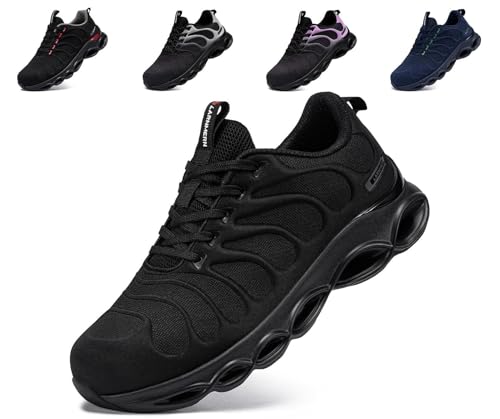


DRRHINO
DRRHINO Steel Toe Shoes for Men Women Lightweight Safety Work Sneakers
ASIN B0DT417MZ1
View on Amazon
Sources and model documentation
Frequently asked questions
Lightest Steel Toe Shoes: How to Compare Weight FAQ
How much do steel toe shoes weigh?
There is no single useful number because size and construction vary. Obtain exact model, sample size, and one-shoe or pair context before comparing published weights.
Are composite toe shoes always lighter?
No. The full upper, outsole, hardware, cushioning, and size determine total weight. Compare complete shoes rather than cap materials in isolation.
Do lighter work shoes reduce fatigue?
Lower swing weight may be preferred during high step counts, but fit, stability, flex, floor, and individual factors also matter. No specific comfort outcome is guaranteed.
Which catalog shoe is the absolute lightest?
The catalog lacks consistent numeric measurements across equivalent sizes, so an absolute ranking would be unsupported. Marketing terms such as ultra-lightweight cannot establish a measured ranking.
Final verdict
What to do next
Use lightweight wording to form a shortlist, not crown a winner. Get comparable measurements in the same size, then evaluate how the complete shoe moves. The BAIYIJIA, LARNMERN, Ruivina, DRRHINO, and Hogent titles provide leads whose construction and weight still need confirmation.
The correct objective is the lightest shoe inside the set that meets every work requirement and fits securely. A heavier verified pair with better control is a better choice than an unsupported or unstable numerical winner.
Compare Steel Toe Shoes